


Chapter 229
I recently gave a lecture in Paris. With the ongoing conflicts in Ukraine and Iran, choosing flights has become increasingly difficult. Even after three months, there is still no clear path toward resolving the conflict involving Iran. Since fares were relatively inexpensive, I had originally booked an Emirates flight via Dubai, hoping the situation would be settled quickly. However, as Japan’s Ministry of Foreign Affairs had issued a travel advisory, I canceled the reservation shortly before departure. Fortunately, I was able to secure a reasonably priced direct flight to CDG on Air France.Living in an island nation like Japan can sometimes make one less aware of the realities of international affairs. For that reason, I believe overseas business trips are important because they provide a firsthand sense of global tensions and developments.
I have also found that smaller conferences, where organizers carefully select speakers, are often more effective for understanding industry trends than large conferences such as those held in Los Angeles. Due to the impact of ongoing conflicts, attendance at this event was lower than expected, and the conference combined three fields—recycling, environmental science, and optics. As a result, I had the opportunity to hear presentations that I would not normally attend, which made the event particularly interesting.
One presentation was given by a Canadian university professor who happens to be a friend of Elon Musk. According to him, Musk genuinely believes that humanity faces the possibility of Earth's destruction and is therefore seriously considering the colonization of Mars. The professor argued that solving humanity’s problems requires “implosion.” While implosion is a technology used to trigger nuclear weapons, his point was essentially that preventing nuclear war requires a force or transformation of a similar magnitude. The discussion eventually arrived at a philosophical conclusion: that natural farming could serve as a means of creating such an implosion.
After the lecture, I was asked for my opinion. I responded that scientific and technological progress is still a work in progress. Along the way, it inevitably generates waste and consumes large amounts of energy, but it has steadily become more efficient over time. The ultimate vision is a completely closed-loop system with zero waste and 100% energy recovery. Therefore, I believe the key to solving our problems lies precisely in continued scientific and technological advancement.
The idea of returning to nature may appeal to affluent people in developed countries who have already experienced a certain level of prosperity. However, it is unrealistic to expect all 8.3 billion people on Earth to sustain themselves through natural farming alone.
For example, the AR glasses equipped with microLED displays that we are developing could eliminate the need not only for televisions but even for smartphone-sized displays. Two transparent displays measuring only about 15 mm by 30 mm each would be sufficient to provide full-color visual experiences. Beyond entertainment, these glasses could function as AI-connected information terminals, enabling users to conduct research, navigate, and manage their health.
Miniaturizing display sizes would not only reduce waste but also dramatically lower energy consumption. Batteries themselves could become much smaller, and charging times would be shortened. Moreover, these devices would offer benefits beyond entertainment and convenience. By incorporating functions such as telescopic and microscopic vision, they could provide users with enhanced visual and auditory capabilities. They could also become revolutionary assistive devices for people with disabilities.
Scientific and technological progress has undoubtedly created many problems since the twentieth century, including pollution and labor rights issues. Yet humanity has continued to confront and address these challenges. The ongoing shift toward electrification is, in many ways, inevitable from the standpoint of energy efficiency. Jet aircraft and internal combustion engines, which operate while releasing exhaust emissions, are extremely inefficient when viewed from the perspective of energy recovery.
Today, as the potential risks posed by AI become increasingly apparent, the notion of a self-aware AI judging humanity’s reckless behavior as a threat to Earth is no longer merely the subject of science fiction films. With current technology, complete recycling of resources and energy remains impossible. Nevertheless, it is essential that humanity demonstrates to AI that we are tirelessly striving toward that goal every day.
In that sense, perhaps natural farming does have a role to play after all. (Laugh)
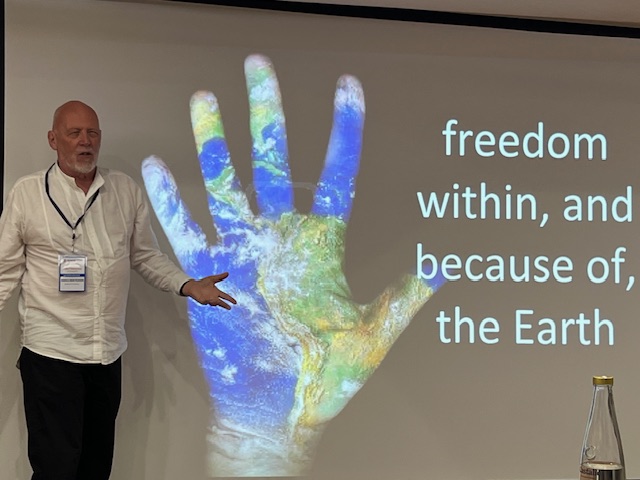
"To prevent AI nuclear war, Implosion is necessary?”
Peter Timmerman, York Uni. Canada
June 1, 2026 (Reiwa 8)
Reflections from a Lecture in Paris
