

Chapter 227
While clashes were ongoing in Iran, I traveled to London for a lecture. Instead of my recently favored airline, Etihad Airways of the United Arab Emirates, I chose a flight with Asiana Airlines. I felt it would be reckless to travel via Abu Dhabi while the region was effectively in the midst of turmoil. Although flights seemed to be operating, the thought of a worst-case scenario was frightening. With Asiana, the route flies north of Iran, over Kazakhstan, so there was no risk of being shot down; however, due to military exercises, I was held up for an extra two hours at Incheon Airport. The details of the exercises were not disclosed, but the effects of war are felt in many places. I had worried that rising fuel costs might result in a surcharge, but that did not happen. Also, compared to heavily spiced Arab meals, the Korean in-flight dishes such as bibimbap and bulgogi were quite enjoyable.In addition to the vast and impressive Terminal 2 at Incheon Airport, I was struck by the spirited performance of soldiers in colorful traditional attire (the Royal Guard Changing Ceremony). The country clearly promotes entertainment such as films and music as export industries. It already seems to have established a position surpassing Tokyo’s Narita as Asia’s leading hub airport. While Japan’s GNP ranking has declined over the “lost 30 years,” not only industrial policy but also shortcomings in infrastructure development—such as airports and ports—have had a significant impact. One cannot help but wonder what the country has been doing over these past three decades. The sense of loss extends not only to the time wasted but also to the returns that should have been gained through proper investment.
As for London, which I last visited in the autumn of last year, things were largely unchanged except for a (surprisingly small) anti-war demonstration. Buses and the Underground were operating as usual. What surprised me was the relative lack of war coverage on television compared to Japan. Not only the public broadcaster BBC, but also commercial stations mainly reported on everyday incidents and accidents, making one wonder whether some form of media restraint was in place. This contrasts sharply with Japanese broadcasters, which tend to overreport on the war situation and react sensitively even to social media posts by President Donald Trump. Being accustomed to detailed war coverage in Japan, I found myself impatiently checking online news.
This may reflect the current situation in the UK. With a diverse population including Europeans (Spanish, Nordic, etc.), Indians, Arabs, and Chinese, Britain is even more of a melting pot than the United States. Covering Middle Eastern conflicts originating from Israel risks inflaming tensions regardless of which side is taken, potentially making it a target for terrorism. As the saying goes, “let sleeping dogs lie,” and there may be a tendency to focus on safer, less controversial topics. When it comes to terrorism in the UK, the Northern Ireland conflict comes to mind, though it has largely subsided in recent years.
With some free time, I rented a car and visited the Cotswolds. After driving about an hour from London, the scenery changes completely—not only from urban to tranquil countryside, but also in terms of demographics, becoming almost entirely white. At a large suburban supermarket, a Japanese person stands out. I was also frustrated that simply passing through Oxford by car (even on the highway) incurs a toll (which must be paid online in advance); perhaps this reflects a certain exclusivity among the white population.
As for the lecture itself, all the participants were Chinese, and the chairman was a professor at a British university of Chinese descent. Most presentations were related to lasers, giving a strong impression that leadership in research and development has shifted to China. Recently, I can’t help but wonder if it’s just my eyes playing tricks on me that President Trump’s “MAGA” looks like “WAGAMAMA” (selfishness in Japanese). (laughs)
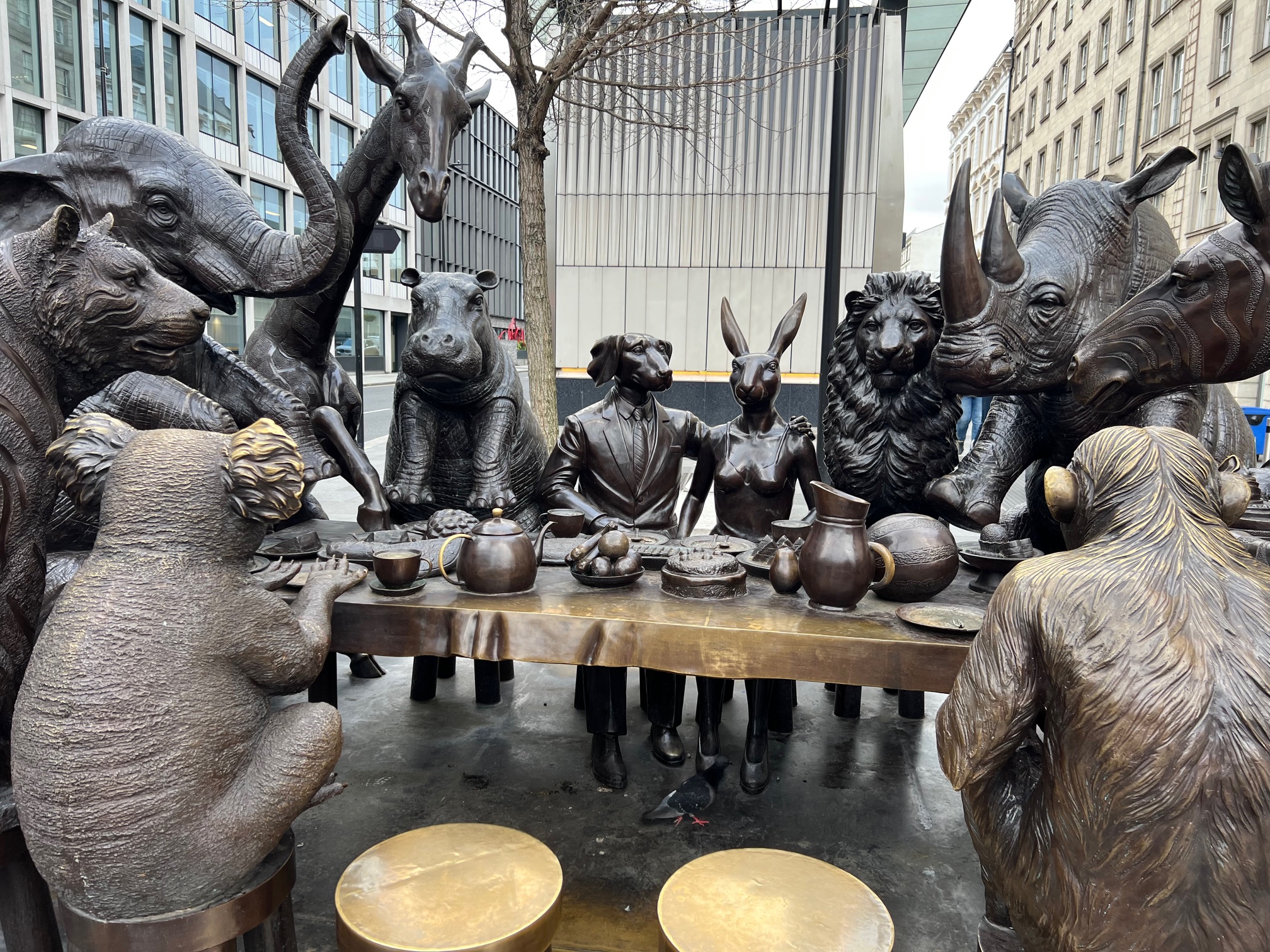
"Multi-ethnic Britain" (Bronze statue at Paddington Station)
April 6, 2026
Reflections from a Lecture in London
