


Chapter 232
The cause of the devastating debris flow in Nepal is believed to have been the massive collapse of a glacier and the surrounding bedrock at an elevation of around 5,200 meters. Mount Fuji is 3,776 meters high, so this was roughly 1.4 times higher than Mount Fuji. A huge volume of debris came rushing down a steep valley at a speed of 167 km/h. The footage showing bridges and buildings being swallowed up by the tremendous force of the flow was truly shocking. In Japan, meanwhile, heavy rains caused by the autumn rain front and typhoons, although on a much smaller scale, resulted in flooding in Chiba Prefecture, Ishikawa, Toyama and Fukui prefectures, and Aomori Prefecture, inundating land and buildings.The fundamental cause of all this is global warming. Yet when we look at greenhouse gas emissions by country, China ranks first at 32.4%, followed by the United States at 12.8%, India at 8.0%, Russia at 4.9%, and Japan at 2.7% (JCCCA statistics for 2023). The top three countries alone account for more than half of global emissions.
It is understandable that the size of a country's territory is to some extent correlated with the amount of greenhouse gases it emits. However, the fact that Japan, a relatively small country, ranks fifth is surprising, especially considering the transformation of its industrial structure. Many manufacturing operations for automobiles, semiconductors, electronic components, and both white and brown consumer electronics have moved to China, Southeast Asia, and other regions.
According to data released by Japan's Ministry of the Environment in 2024, Japan's greenhouse gas emissions are broken down as follows: approximately 40% comes from the energy conversion sector, including power generation; 24% from the industrial sector, including factories; approximately 19% from transportation; and 5% from the commercial and office sector. Emissions have continued to decline since 2013, and in 2024 they fell below the 100-million-ton level and have continued to trend downward.
In other words, Japan's greenhouse gas emissions have been declining along with the country's declining economic strength, yet Japan still remains in the surprisingly high position of fifth place. It is a rather troubling situation.
U.S. President Donald Trump called measures to combat global warming "the biggest scam in the history of the world" and withdrew the United States from the Paris Agreement. It is difficult to describe such a decision as anything other than foolish.
There are concerns that the intensifying competition to develop AI semiconductors will lead to a severe shortage of electricity in the future. We therefore need to restrict power generation based on fossil fuels and, in particular, build power plants that can minimize carbon dioxide emissions.
Electricity generated from renewable sources such as solar, wind, and hydropower is relatively inefficient, making these sources unsuitable for generating the enormous amounts of electricity that AI will require. If that is the case, nuclear power becomes our most reliable option.
Interestingly, with the exception of Japan, all of the countries among the world's top greenhouse gas emitters possess nuclear weapons. In other words, they possess nuclear technology not for peaceful purposes, but for the purposes of war. According to SIPRI statistics for 2025, the number of nuclear warheads possessed by these countries—capable of destroying other nations at the decision of their leaders—is estimated at 5,328 for the United States, 5,580 for Russia, 500 for China, and 172 for India. Yet the conflicts between Ukraine and Russia, and between the United States and Iran, demonstrate that possessing nuclear weapons does not necessarily serve as a deterrent to war. I believe that now is the time for world leaders to unite and work together toward the peaceful use of nuclear technology.
Instead of spending enormous amounts of money on weapons development and military expansion, we should direct those resources toward developing ultra-small nuclear power generators, like the compact nuclear power source depicted as being installed in the chest of Iron Man in the Hollywood science-fiction film Iron Man, or in the chest of Atom in the Japanese manga Astro Boy.
Science and technology have the power to make people's lives happier when used correctly, but they can also make people miserable when used improperly. As AI continues to advance, a society in which humans and robots coexist will eventually emerge. Just like nuclear weapons, AI and robots could also become weapons if they are used in the wrong way.
Today, natural disasters and advances in science and technology can no longer be considered separately. How can we stop the climate change that is occurring around the world? I believe we have reached the point where we must seriously consider this question.
President Trump! If you stop the wars and foster businesses that improve the environment through the peaceful use of nuclear technology, you could aim for both financial success and the Nobel Peace Prize.
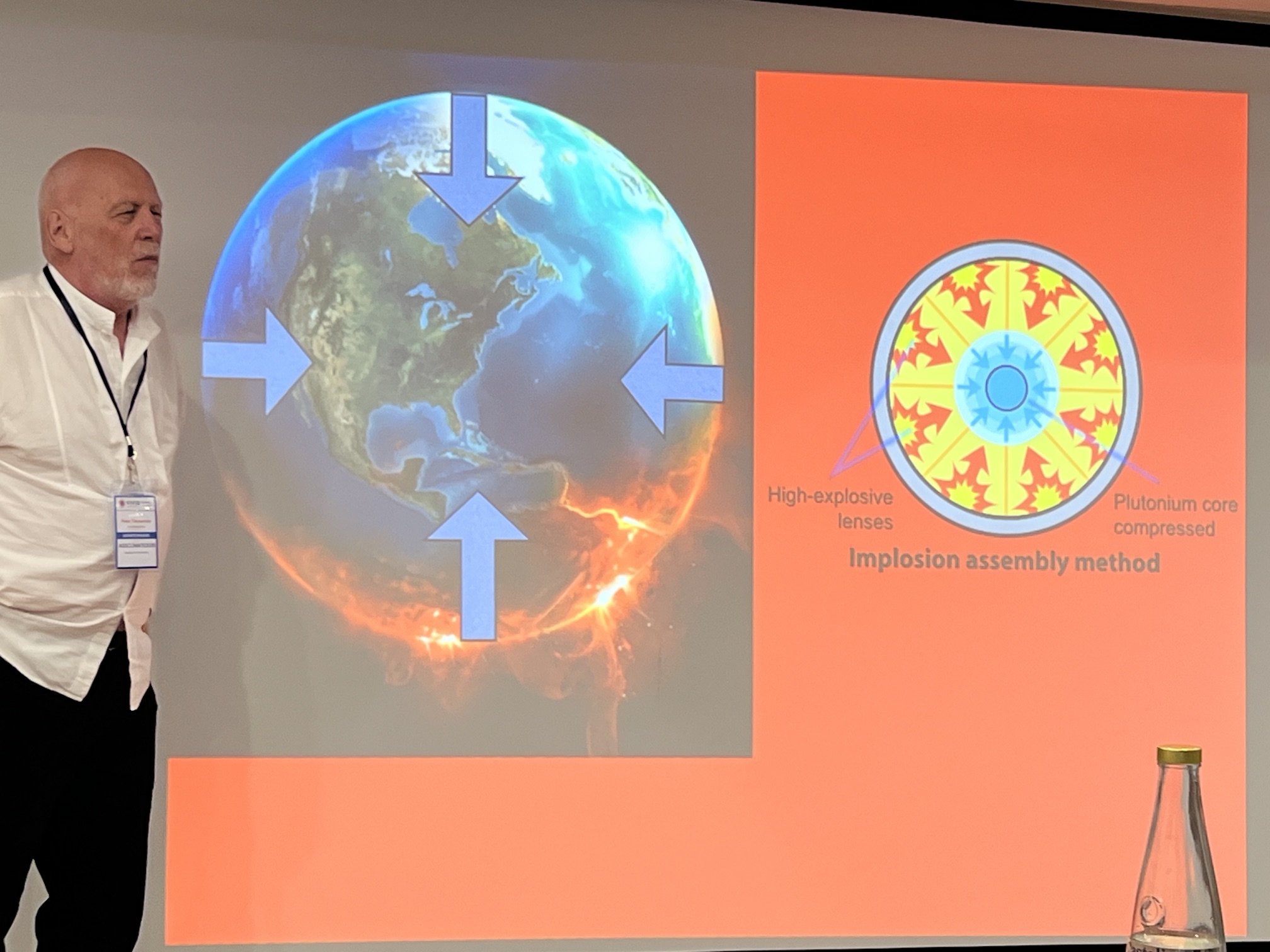
How is the "implosion" suggested by Professor Peter Timmerman of York University triggered?
September 4, 2026
Thoughts on the Debris Flow in Nepal
