

Chapter 228
I attended Display Week 2026, hosted by SID at the L.A. Convention Center, for the first time in quite a while. Since the event was held while the conflict between Iran and the United States was still unresolved, I was concerned about the possibility of terrorism in Los Angeles, but fortunately nothing happened. Airplanes flying over the Pacific Ocean are relatively reassuring, yet places where large numbers of people gather inevitably create a sense of unease. Since most exhibitors and visitors were Chinese companies and Chinese attendees, Iran was not foolish enough to antagonize China as well.Perhaps due to the display market for TVs, PCs, and smartphones shifting from expansion to contraction, the corporate booths at the exhibition appeared somewhat modest. Even so, the show clearly demonstrated that China has now taken the lead in cutting-edge display development. The aggressiveness and ambition of Chinese display manufacturers far surpass those of former leaders such as South Korea, let alone Japan.
LCDs are now becoming vintage technology, while the mainstream focus has shifted to advanced OLED technologies, μLED, and μOLED displays. My main interest lies in μLED displays, but there are many different technical approaches. For example, the choice of backplane technology alone—whether PCB-based passive matrix or TFT-based active matrix—makes a huge difference. On top of that, there are further distinctions such as simultaneous emission versus progressive emission. The technologies vary dramatically depending on which method is adopted.
Moreover, display sizes, shapes, and features are becoming increasingly diverse, so the discussion is no longer simply about larger screens, higher resolution, or greater brightness as it once was. One particularly interesting concept was displays that intentionally lowered brightness in order to create softer, more artistic images. Surprisingly, I found myself liking them very much and even wanting one for my home.
There were also a wide variety of demonstrations on display. Some, like those from BOE, achieved slim large-screen displays using μLED (strictly speaking, mini-LEDs since the chip size was around 300 microns). Others, such as AUO, demonstrated transparent displays capable of providing information in an AR-glasses-like format.
It seemed to me that the future direction of display technology is no longer centered on large screens, but rather on augmented reality and virtual reality. The evolution of AI is also beginning to transform displays. In other words, AI can enable displays that provide vision surpassing human capability—allowing people to observe distant or microscopic objects as though they possessed superhuman eyesight.
I became convinced that the AR glasses commonly depicted in science fiction films will eventually become reality through the fusion of sensor technology, display technology, and AI. Now that the smartphone market has reached saturation, the industry is eagerly waiting for the next man-machine interface (MMI). I feel that the day when AR glasses emerge as a leading candidate for that next-generation MMI is not far away.
The first generation of AR glasses may even cost more than ten million yen. However, AR glasses that dramatically enhance human vision and hearing—and even function almost like an extension of the brain—could be readily accepted not only by people with disabilities, but could also fundamentally transform the lifestyles of healthy individuals.
For example, when traveling from Los Angeles Airport to a hotel downtown, people today search on their smartphones, compare various transportation options such as cars, trains, buses, or Uber, and then make reservations online or by phone. In the future, however, AI may automatically arrange an Uber in advance based on one’s personal lifestyle and preferences, leaving the user simply to follow the instructions displayed on their glasses. Even if the person suddenly decides to travel more cheaply by train instead, the AR glasses could instantly arrange the train ticket as well.
I sometimes wonder whether life could become too convenient, causing the human brain itself to deteriorate… (laugh).
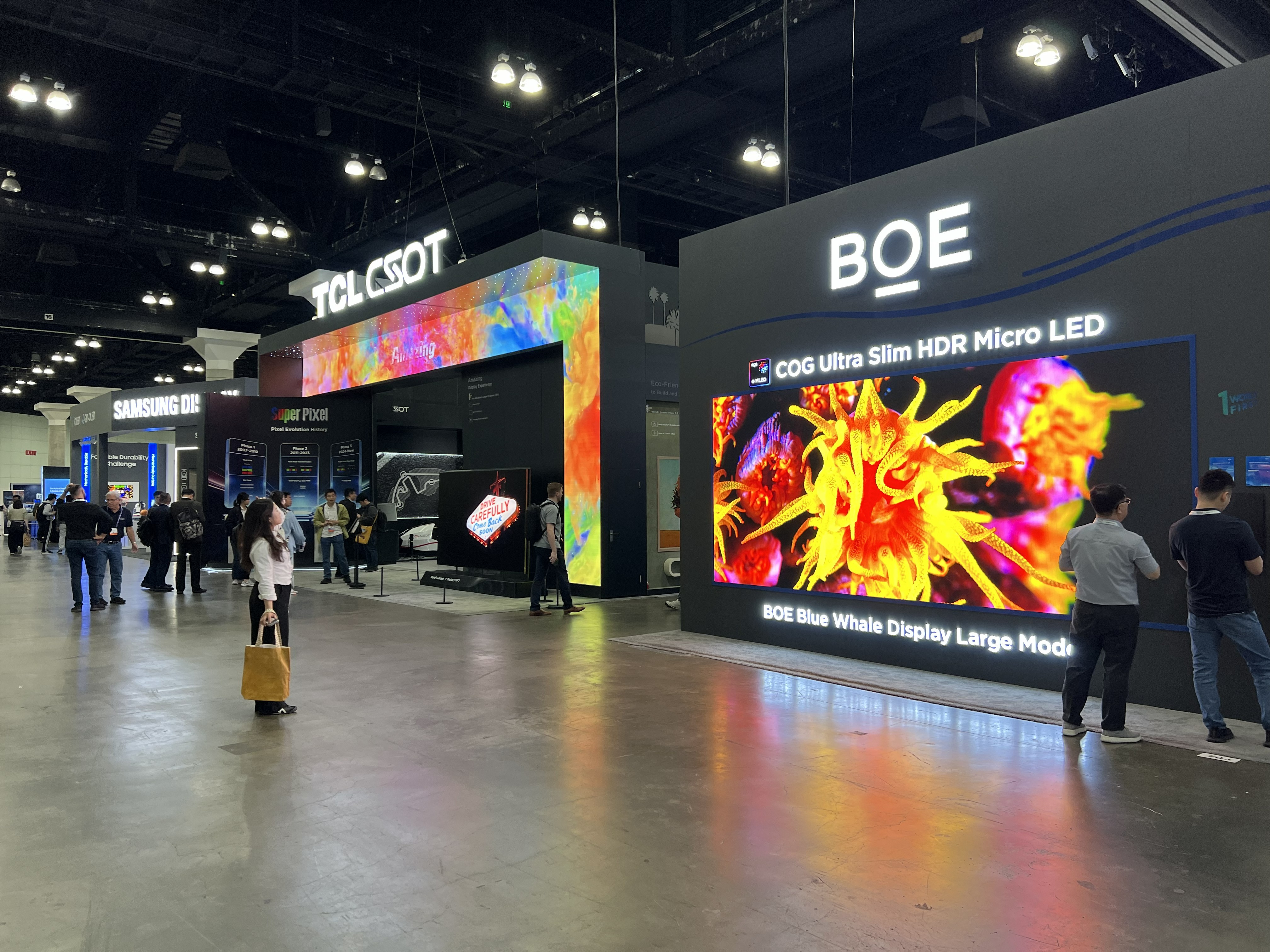
The main focus of the exhibition and presentations was Chinese display companies.
May 13, Reiwa 8 (2026)
Thoughts on Display Week 2026
