


Chapter 223
I traveled to London to give a lecture. I stayed with a host family in Oxford for about a month when I was a student, but returning after forty years left me with a very different impression. At the time, the British economy was in very poor shape, while Japan, by contrast, was advancing rapidly and globalizing at breakneck speed.The British car manufacturer BLMC (British Leyland) was undergoing restructuring under government control and was using Honda engines. My host family consisted of four people: the father was unemployed, and the mother supported the household by working part-time at a BLMC factory. I remember that eating a hamburger at McDonald’s was considered a luxury, and that I talked with the father about how eager he was to learn a great deal from Japan. Even so, the exchange rate was still around 300 JPY to the pound, which made life tough for a student. Lunch at McDonald’s was not really an option, and when I stopped by Soho to eat Chinese food instead, the ramen tasted so strange that I could hardly eat it. Being insensitive to food was common in those days, but things have improved dramatically since then.
Today the exchange rate is around 200 yen to the pound, so compared with Switzerland, prices do not feel outrageously high. Still, because I have the image of rates being around 100 yen, everything strikes me as expensive. I have no idea what became of Matthew, who was nine at the time, or Karen, who was three, but given the orderly and clean atmosphere of the London suburbs—more so than Japan, thanks to regulations—I imagine they are living happy lives. The cityscape, where old buildings stand side by side with modern skyscrapers, is uniquely London. Unusually shaped buildings are beautifully illuminated at night. More striking than the scenery, however, is the change in ethnic composition. According to statistics, London’s population is 59.8% White, 18.5% Asian, 13.3% Black (once rare at the time), 5.0% Mixed, and 3.4% Other (Global Market Surfer 2020). But judging by the people I passed on the street, those of Indian and Arab descent seemed more numerous than White residents. Like Freddie Mercury, the vocalist of the rock group Queen, I felt that immigration from former colonies has increased significantly.
It is said that the influx of illegal immigrants and the rise in crime were among the factors leading to the UK’s withdrawal from the EU (Brexit), while I also hear that wealthy seniors prefer to move to the suburbs. Japan, too, will inevitably have to actively accept foreign talent in order to rebuild its economy, but since there are negative aspects as well, it is necessary to study precedents and put countermeasures in place beforehand.
Britain’s GDP ranks sixth in the world (IMF 2025), below Japan, but its GDP per capita ranks 23rd (IMF 2025), well above Japan’s 38th. This is due to the strength of the GBP, but I am concerned about how the current JPY depreciation will affect Japan’s national strength in the future. There may be unavoidable drawbacks due to the weaknesses of a coalition government, but the continued reliance on handouts runs counter to the “small government” philosophy firmly pursued by Prime Minister Margaret Thatcher (1979–1990).
Before Thatcher took office, major industries such as telecommunications, gas, aviation, and automobiles were state-owned in the UK, and inefficient management had driven inflation to a frightening 27%. By privatizing state-owned enterprises under the banner of neoliberalism, inflation was brought under control, but unemployment exceeded three million in 1982, marking the largest increase since the Great Depression. This was the result of adopting monetarist policies advocated by Milton Friedman, in contrast to the aggregate-demand–focused Keynesian economics. The current Takai chi administration, however, seems intent on stimulating the economy with outdated Keynesian policies.
In any case, the scale of the economy today is far too different from that of forty years ago. Attempting to tackle inflation and unemployment in this way is like fighting with a squirt gun. I would like to see a bold display of steely resolve and a clear priority placed on fiscal reconstruction.
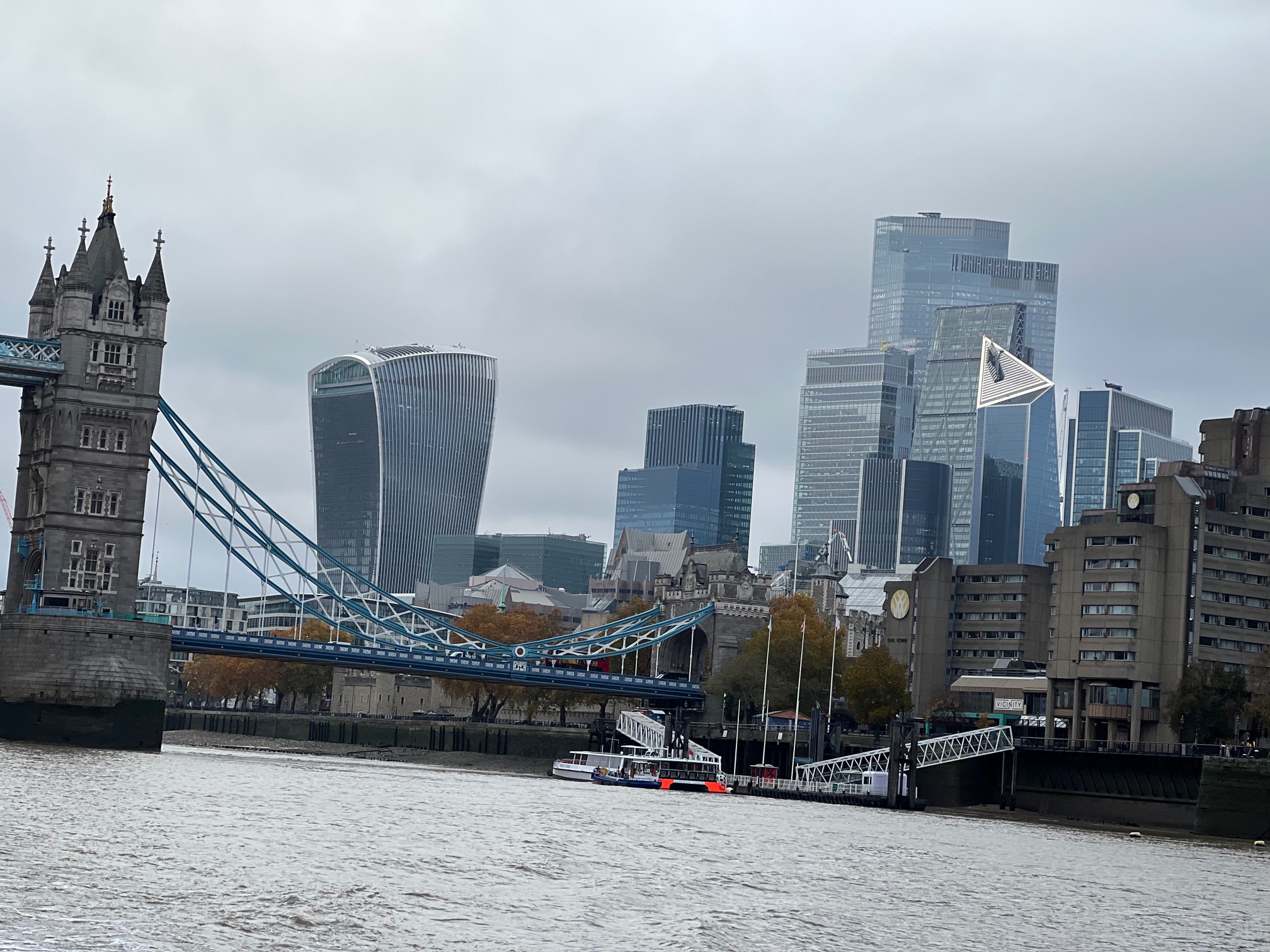
London Bridge and Skyscrapers
December 1, Reiwa 7
British Prime Minister Thatcher and Japanese Prime Minister Takaichi
